Big Injun Woods
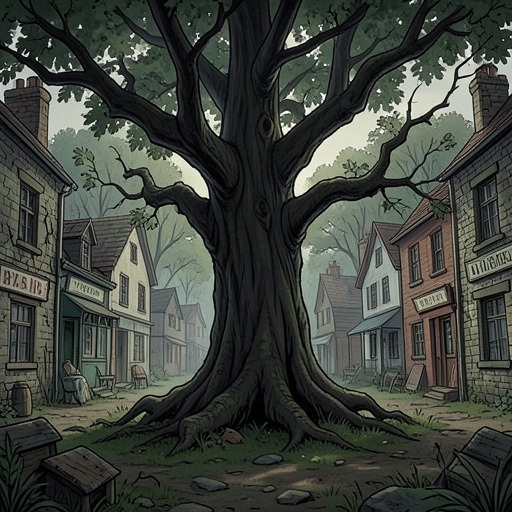
The TommyknockersBig Injun Woods, labeled Burning Woods on some maps, is the forest adjoining the old Garrick place and the center of the buried-ship mystery. Its reputation for disorientation and misfortune precedes the excavation, while its roads, hidden ground, and narrowing paths later govern who can approach the ship, who can leave Haven, and who is caught in the disaster surrounding its emergence.
Setting and Names
The woods lie east of the Derry Road and extend behind the old Garrick place; Nista Road runs west from the highway toward a gravel pit at the forest’s edge. Ev Hillman’s map work places the land inside a sequence of circles, with Bryant and Marie Brown’s house within a broader boundary and the old Garrick property at the center of the smallest circle he draws. The maps use Burning Woods, but Ev recognizes it as the same forest that he and other Haven residents call Big Injun Woods.
The name carries a history of colonial displacement. The forest was called after Chief Atlantic, whose proper Micmac name was Wahwayvokah, meaning “by tall waters.” White settlers used the contemptuous translation “Chief Atlantic.” After influenza decimated his people in the 1880s, Wahwayvokah led survivors south; he died in 1885, reportedly declaring on his deathbed that the woods where he had brought them were cursed. Two white witnesses reported the declaration, but the story leaves uncertain whether he meant to pronounce a curse or describe a condition already present. His grave was eventually lost, leaving the forest’s name as his only monument.
Reputation and Disorientation
Ev’s remembered history gives the woods a long record of accidents. He recalls at least a dozen hunting mishaps, many involving guns, including deaths, injuries, and two November murders. Hunters also regularly became lost; search parties went out most years, and some people were never found. The danger was not restricted to inexperienced visitors: even lifelong Maine hunters sometimes needed rescuing or emerged only by luck.
Compasses were said to fail in the forest, pointing in the wrong direction or spinning without settling. Ev remembers his father’s explanation that a buried mass of magnetic rock might disrupt the needles. Experienced woodsmen learned not to depend on a compass and instead used streams, roads, or power pylons to find their way out. The remembered case of Delbert McCready makes the hazard concrete: after entering with a shotgun in November 1947, he failed to return, prompting a search that grew from twenty people to two hundred. He finally emerged along Preston Stream, pale, dazed, and substantially lighter than when he had gone in.
The Buried Presence and the Dig
The forest’s strange effects become part of Ev’s attempt to understand what is happening around Haven. He suspects that something underground in Big Injun Woods disrupts both compasses and human minds. The object lies on land willed by Frank Garrick to his niece, Bobbi Anderson, who has been excavating it with Jim Gardener. Ev connects the noises of heavy earth-moving machinery to the work and concludes that the disturbance is centered on the old Garrick property.
During the hot spell from July 12 through July 19, Bobbi’s rebuilt truck can be heard in Haven Village as it works at the farm. The dig is already consequential beyond the property: Justin Hurd’s transformation has led him to build a harmonic-wave machine intended to drive rabbits and woodchucks from his garden, but its vibrations could trigger a devastating earthquake. Beach Jernigan dismantles it while Justin is away, with the expectation that dangerous devices may need to be dismantled again if he rebuilds them.
When Ev and Butch Dugan reach the excavation, they find a slash more than three hundred yards long and as much as sixty feet wide. Bobbi’s old truck, a converted payloader, a chainfall, a chipper, fuel cans, and a diesel drum mark the scale of the operation. The opening in the hillside exposes a polished silver-gray surface: ninety feet of the spacecraft projects from the earth, with more still buried. The forest’s old uncertainty has acquired a material center, but uncovering it does not make the place safer or easier to understand.
Boundaries, Routes, and Escape
Big Injun Woods is linked to the barrier that makes Haven difficult to leave. Ruth McCausland encounters resistance as she tries to walk out: the air seems elastic, and the invisible obstruction pushes her back. Her experience echoes Gardener’s earlier difficulty reaching into Bobbi’s customized water heater, tying the town’s boundary to the alien force associated with the excavation. The woods thus sit at the edge of a landscape that is both geographically traversable and practically sealed.
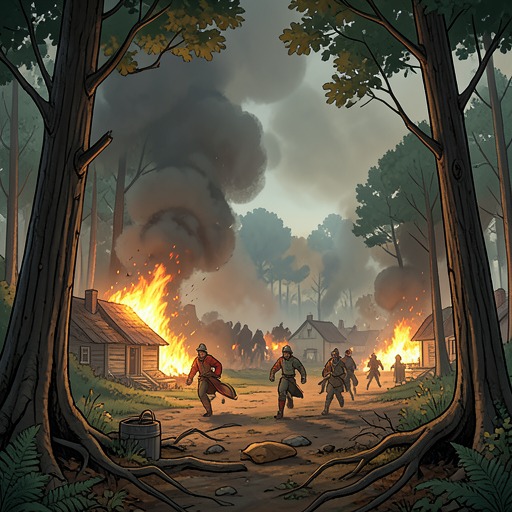
They also provide a route into the hidden site. Ev expects the machinery used by Bobbi and Gardener to have left a clear backtrail through the woods, and later he and Dugan follow the track toward the farm. When they arrive, the Cherokee drives across Bobbi’s garden and reaches the rutted track leading into the trees. During the final fire, Gardener escapes along a path into Big Injun Woods on the Tomcat. The route gives him a chance to get ahead of the flames, while four of the Tommyknockers who attempt to follow are killed when the fire cuts off the way.
Fire and Narrative Significance
At the climax, the woods become both the path of escape and the site of mass death. A spreading wall of fire advances from the farm and reaches the clearing where the ship has stood. When the ship rises, its draining power subsides before the fire reaches the clearing, allowing a few people to limp farther into the forest. But going directly west only leads toward air they cannot breathe; survivors must turn north or south to work around the fire front. Most people do not make it out, and many die within feet of the empty socket left where the buried object had been.
The forest’s changing names and accumulated stories give the catastrophe a longer historical frame. The old account of a curse, the repeated compass failures, and the modern disruption of minds and machinery all meet in one landscape, without reducing its mystery to a single cause. Big Injun Woods is at once a local place with roads and hunting histories, a threshold around the alien excavation, and a terrain whose passages determine the difference between escape and entrapment.